
The Legal 500 — usually shortened to "Legal 500" — is one of the legal rankings clients, journalists and graduate recruits use to place a firm. It is both a firm ranking and an individual ranking: practice groups and individual lawyers are assessed.
What is Legal 500?
Legal 500 was founded in 1987 by John Pritchard — by its own account "the original clients' guide to law firms, the first of its kind". Today Legal 500 describes itself as a platform covering providers and users of legal services "in over 100 countries worldwide".
It is not a directory you sign up to, but an editorial market study. According to Legal 500, the rankings are comparative assessments within a defined jurisdiction and practice area: firms are not measured against a fixed formula but relative to the other firms active in the same market. Taking part is free: "Law firms appear in the editorial sections of Legal 500 free of charge."
Which markets Legal 500 covers
For the German market Legal 500 runs a dedicated country line — Legal 500 Deutschland — and even its own German-language website at legal500.de. Austria and Switzerland are covered as separate jurisdictions within the wider European coverage.
Legal 500 is not a single ranking but a family of regional lines. For an internationally active firm that means it can be ranked in several lines at once — but has to file separately in each, to different deadlines.
How the assessment comes about
The submission. The firm files a structured document: matters from the review period, firm size, joiners and leavers, practice groups and its own positioning against competitors.
The client referees. The firm names clients who can speak about the working relationship. Whether that produces usable feedback is decided beforehand: referees who do not know the request is coming, or what it turns on, frequently do not reply at all.
Legal 500 points out expressly that not every one of these sources is available for every firm in every research cycle. The placement is made on the basis of the evidence available overall.
There is no single decisive metric: "There is no single factor that determines ranking position; instead, decisions reflect relative performance compared to other firms and practitioners in the same market."
Interviews are conducted with a selection: "As part of our comprehensive research process, interviews are conducted with a representative selection of firms, chambers and practitioners each cycle. The absence of an interview does not negatively affect assessment."
A note on wording: where Legal 500 writes „chambers“ it means barristers' chambers — Legal 500 runs a separate UK Bar guide in which barristers' sets are ranked. The word does not refer to the ranking provider Chambers and Partners.
What Legal 500 assesses
Legal 500 states that research teams assess firms and practitioners "against a range of qualitative and comparative factors, which may include":
- subject matter and practice area expertise
- complexity and quality of work
- strength and depth of team
- depth and breadth of practice area coverage
- industry sector expertise
- strength of client base and long-term client relationships
- market visibility, brand strength and reputation
- comparative market positioning
- ancillary and cross-practice capabilities
- international or cross-border expertise
- innovation, legal technology, and service delivery capabilities
Legal 500 notes that relevance and weighting of criteria and evidence sources "may vary according to the ranking product and market being researched", and that not every evidence source is available for every firm in every cycle.
What the tiers mean
Legal 500 places firms in tiers, with tier 1 at the top. Within a tier firms are listed alphabetically — Legal 500 asks readers to "bear in mind that firms are ranked alphabetically within tiers". The visible order within a tier is therefore not a ranking order.
Alongside the firm tiers, individual lawyers are ranked in four categories. Legal 500 names them in its EMEA guidelines as "hall of fame, leading partner, next generation partners and leading associates". The guidelines list several indicators side by side for each. For a leading partner they name "at least five years as a partner" alongside "lead roles on multiple significant matters", "widespread recognition by market peers" and "exceptional client endorsements" — seniority is one of four points, not the entry ticket. Next generation partners are those with "up to five years as a partner".
Rising stars and leading individuals: how Legal 500 ranks individual lawyers
The names of the individual categories differ between editions. The EMEA guidelines quoted above speak of leading associates; the US submission guidelines for the 2024 edition listed three categories — "leading individual, next generation partners and rising stars". There, a Legal 500 rising star is one of the "lawyers below partnership level who appear frequently on significant matters and are widely cited by peers and/or clients".
The same US guidelines draw a line that matters for every submission: any lawyer mentioned in the editorial text is "recommended", while a "ranked" lawyer "has achieved a ranking in the Hall of Fame, Leading Individuals, Next Generation Partners or Rising Stars". Candidates for rising stars are named in the submission with their "position, length of legal practice and areas of expertise". Before you nominate an associate, check in the guidelines of your own edition which category applies there.
In our experience the tier reflects the size of the practice group and the volume of matters filed as much as anything else. For many mandates the strongest firm in tier 3 is the better fit — a tier is a market position, not a quality certificate.
What a Legal 500 ranking is worth
- Legal 500 is one of the rankings clients and journalists ask about regularly. In our experience a ranking makes conversations about new mandates easier — Legal 500 publishes no hard figures on that effect.
- Legal 500 describes its reach as "over 100 countries worldwide" and covers smaller jurisdictions and specialised practice groups too. That figure describes the platform as a whole, not the number of ranking lines.
- Taking part and being ranked are free of charge. Legal 500 states in its EMEA guidelines: "Law firms appear in the editorial sections of Legal 500 free of charge."
- Work highlights should as a rule fall within a twelve-month window — for the EMEA 2027 cycle "between August 2025 and July 2026". For a first submission in a practice area Legal 500 expressly allows more and recommends including "several examples from the previous two years, as well as at least 10 new examples of work". The window is not rigid otherwise either: "If you think older work is significant … then please do mention it and explain why it is of interest."
New in the 2027 cycle: US State Rankings
Legal 500 has announced an "enhanced US coverage framework" for the 2027 edition. Exactly one new ranking line is being added: US States, which Legal 500 describes as covering "six major US legal markets" — California, Florida, Illinois, Massachusetts, New York and Texas. The submission deadline is 30 September 2026, with research running from September to December 2026. The Nationwide guide additionally gains two sections that Legal 500 flags as "NEW SECTION" in its practice area list: Whistleblower representation and Food and Agriculture.
For firms with US exposure this means the requirements per submission do not change — there are simply more submissions to file. The full analysis is available at Legal 500 US State Rankings 2027.
Legal 500 or Chambers — what is the difference?
The Legal 500 and Chambers and Partners are two separate legal rankings with their own procedures. The question of how they differ comes up regularly in our first meetings.
What makes Legal 500 demanding
First: the deadlines for a jurisdiction are bundled. That ties up the whole firm at once — unlike Chambers, which spreads its practice areas across the year.
Second: in our experience the reworked portal takes some getting used to.
Third: for the case descriptions the sector uses the term work highlights, and matter descriptions for the individual texts. They do more to determine the outcome than the sheer number of matters filed — at Legal 500 as much as at Chambers.
Legal 500 submission deadlines
Legal 500 publishes the dates for each ranking line in its own Legal 500 research schedule. The market uses the English terms throughout — firms search for Legal 500 deadlines and Legal 500 submission deadlines. We bring together the dates for all relevant legal directories — Chambers, Legal 500, IFLR1000, IAM and others — by jurisdiction in our deadlines overview.
Frequently asked questions about Legal 500
Do you have to pay to be included in Legal 500?
No. Taking part and being ranked are free. Legal 500 states in its submission guidelines: "Law firms appear in the editorial sections of Legal 500 free of charge." Legal 500 does sell advertising and profile products alongside the editorial rankings; its guidelines keep the two apart, directing queries about "directory listings (ie paid-for advertising entries)" to a separate contact.
How does my firm get into Legal 500?
Through two things that both have to be right: a submission filed on time with matters described in substance, and a list of client referees who are prepared for the request. Legal 500 requires referees in a separate spreadsheet by the same deadline and suggests "20 referees per practice area is a good minimum guideline". The researchers read both against each other.
Can a smaller firm be ranked as well?
Legal 500 assesses comparatively within a defined market and practice area rather than against a fixed formula, so a boutique is measured against the firms active in the same market — not against the largest firm in the country. In our experience that makes specialised practices very much rankable.
How Law Business has supported firms since 2004
Law Business has been supporting law firms and patent attorney firms with ranking submissions since 2004 — from one-person boutiques to the largest practices. For Legal 500 we handle the full cycle: selecting guides and practice areas, writing the matter descriptions, managing referees within the applicable limits and filing on time — and our involvement continues after the submission, through to publication and beyond.
See our ranking submission services
The process in six phases
A Legal 500 submission is not a form you fill in over an afternoon. This is what the cycle looks like with us:
What happens after the submission
Months pass between filing and publication, and more is decided in that period than most firms expect. We stay with the submission through to and beyond publication. In practice that means:
Alongside this runs the ongoing project management: we remind you politely but firmly which feedback is still outstanding, and tell you at any time how much time is left before the deadline. You can review the project status whenever you want.
What firms say about working with us
We work for international full-service firms as well as specialist boutiques and sole practitioners. A selection:
"Law Business supported us with submissions for […] Chambers and Legal 500. The cooperation was very professional… We can recommend Law Business without reservation."
DLA Piper Germany
Ann-Christin Vollbrecht · Communication
"… Law Business was able to demonstrate their expertise impressively to the equity partner group."
Freshfields Bruckhaus Deringer
Dr Friedrich Jergitsch · Managing Partner
"Law Business helped us improve our positions in top rankings… Mr Dillinger and his team optimised our entire submission process."
Eversheds Sutherland
Dr Michael Mosimann · Managing Partner
"They have an excellent knowledge of the legal market… I can expressly recommend Law Business for advising law firm partners."
Taylor Wessing
Dr Thomas Adocker · Partner
"If a firm wants to engage seriously with rankings, I would definitely recommend bringing in the Law Business team — it saves a lot of time and frustration."
Niederer Kraft & Frey
Clara-Ann Gordon · Partner & Co-Head Technology
"Law Business helped us achieve an improvement at Chambers and a first entry at Legal 500…"
Braun-Dullaeus Pannen Emmerling
Dr Friedrich Emmerling · Partner
The standard work on law firm rankings comes from us
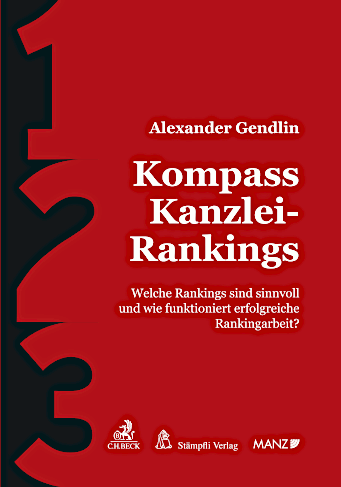
Law Business Managing Partner Alexander Dillinger wrote, in cooperation with prominent rankings including Chambers, Legal 500 and Thomson Reuters, the first book worldwide on law firm rankings — the "Kompass Kanzlei-Rankings", published by C. H. Beck, MANZ and Stämpfli.
Would you like to know which Legal 500 lines are realistic for your firm and what a submission would involve in practice? Get in touch — we will look at your current position and tell you honestly where movement is possible and where it is not.
About this article
Mag. Alexander Dillinger, Managing Partner of Law Business. In the legal industry since 2004, previously Head of Business Development & Marketing at Wolf Theiss and DORDA. Author of the "Kompass Kanzlei-Rankings", published by C. H. Beck, MANZ and Stämpfli — with contributions from Chambers and Partners, The Legal 500 and Thomson Reuters.
The statements about Legal 500 on this page were checked against the original sources at legal500.com, last on 6 August 2026; passages taken from those sources are marked as quotations. If you spot an error, let us know — we will correct it.
"Law Business took over the complete preparation of our ranking submissions… we improved at Chambers and Partners […] and Legal 500."
PHH Prochaska Havranek
Dr Rainer Kasper · Managing Partner
Latest articles on Legal 500
What Legal 500 is changing for client referees right now: