
Legal 500 US 2027: what is genuinely new — and what only looks new
Management Summary
Legal 500 is expanding its US programme for the 2027 cycle. We compared the 2026 and 2027 submission materials in full. The result is narrower than the announcements suggest — but it holds up.
- Exactly one new ranking line: US States. Six states, submission deadline now 30 October 2026 (originally 30 September), inaugural edition April 2027.
- US Private Client grows from three states to six — with a 30 September 2026 deadline.
- The Nationwide guide gains two new sections: whistleblower representation and food and agriculture.
- Everything else is unchanged. The submission guidelines are word for word identical to 2026 — the only difference is the dates.
For firms this means: the requirements per submission do not change. Only the number of submissions grows.
This analysis as a video. The key changes to the Legal 500 US programme, summarised in 1:51 minutes.
Four lines, four deadlines
Legal 500 now runs four separate US submission lines. Firms wanting a presence in more than one need to track four dates — two of which originally fell on the same day.
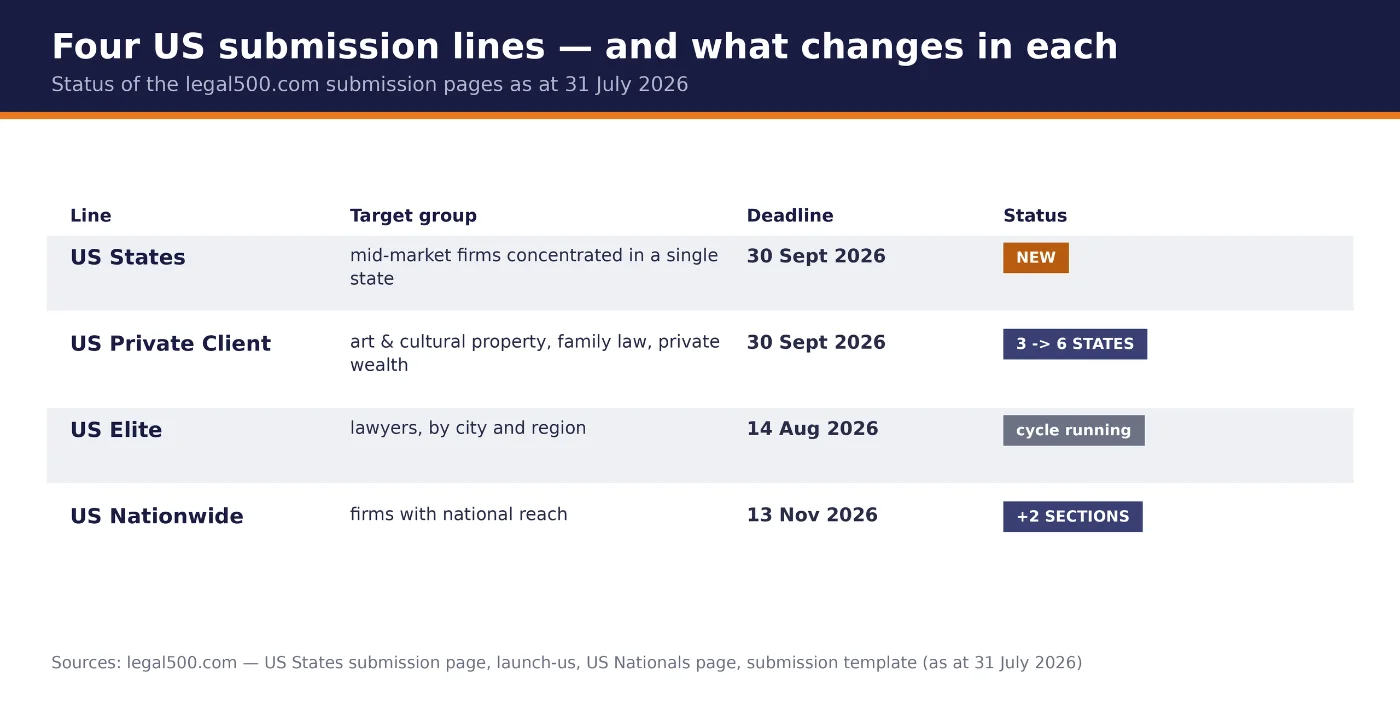
The only genuinely new line: US States
The submission page for the US State Rankings was created in May 2026 and has no predecessor version — unlike every other US line, which carries forward from earlier cycles. Nor are there any published ranking tables yet. This is a genuine first edition.
Firms are ranked across six states: California, Florida, Illinois, Massachusetts, New York and Texas. Legal 500 describes the target group as follows:
We recognise mid-market firms with a strong and established presence within a single US state, combining local market leadership with a broad and credible practice offering. Typically, these firms have established a clear statewide presence across multiple offices or key practice areas and are not part of the Am Law 100.
On the submission page that reads like a profile rather than a rule. In the presentation materials from the Legal 500 webinar of 14 July 2026, Legal 500 is more explicit. Under “Eligibility” the deck states:
Typically 50+ attorneys with flexibility for firms experiencing strategic growth. Not eligible: Am Law 100 firms are excluded.
That puts a figure on it for the first time: the State Rankings target firms from roughly 50 lawyers upwards, with express flexibility for firms in strategic growth — and Am Law 100 firms are excluded. By comparison, City Elite carries the ceiling “typically up to 50 attorneys”, with Am Law 200 firms excluded there.
What is researched in which state
Practice areas are tailored state by state and visibly follow local economic structure: energy appears only in Texas, tax only in New York, technology, media & telecoms only in California. Insurance appears in Florida, Illinois and Texas, white-collar crime in Florida and New York.
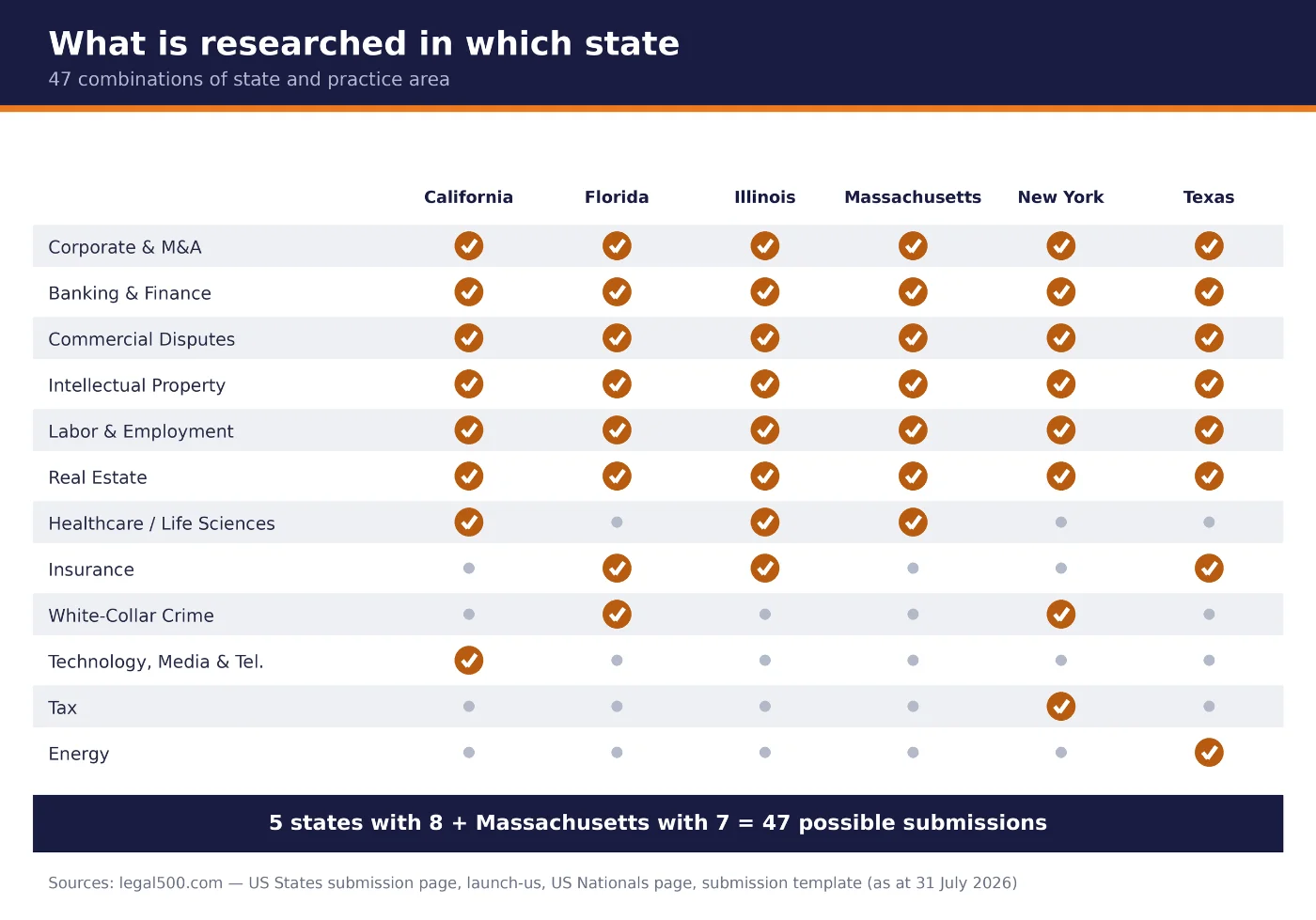
That adds up to 47 combinations of state and practice area. Since the form requires the selection of exactly one practice area, each of those combinations amounts to a separate submission.
The webinar materials name the core areas as mergers & acquisitions, commercial litigation, white collar crime & investigations, real estate and intellectual property, and hold out the prospect of further sub-tables “where depth of market activity supports additional granularity”. The submission form is already broader than those five core areas — firms submitting outside them should have the category confirmed in advance.
Private Client: from three states to six
The US Private Client Guide is not new — it has been running since the 2026 cycle and already has published ranking tables. What is new is its extension: family law and private wealth were previously researched in New York, California and Florida. For 2027, Massachusetts, Texas and Illinois are added — giving Private Client exactly the same six states as the new State Rankings. Art & cultural property remains national, without a state breakdown.
For firms with a private client practice in one of the three new states, this is the real news of the cycle. Both the submission and the client referee deadline fall on 30 September 2026.
Nationwide: two new sections
The Nationwide guide gains exactly two practice areas for 2027 — Legal 500 flags both explicitly as new:
- Whistleblower representation. The definition is tightly drawn: it covers claimant-side representation only. Internal investigations, compliance counselling and defence-side work are expressly excluded. It spans False Claims Act matters as well as securities, tax, antitrust and healthcare programmes, plus retaliation claims.
- Food and agriculture. Legal 500 is looking for firms with sustained sector expertise across the food chain, from venture capital and growth equity financings through private-equity-backed acquisitions to strategic M&A.
Neither area appears anywhere in the 2026 practice area definitions. Anyone submitting here is entering an empty table.
And what stays the same
We compared the submission guidelines for both years line by line. After normalising the dates, not a single substantive difference remains. The same applies to the referee guidance, the FAQs and the main submission form.
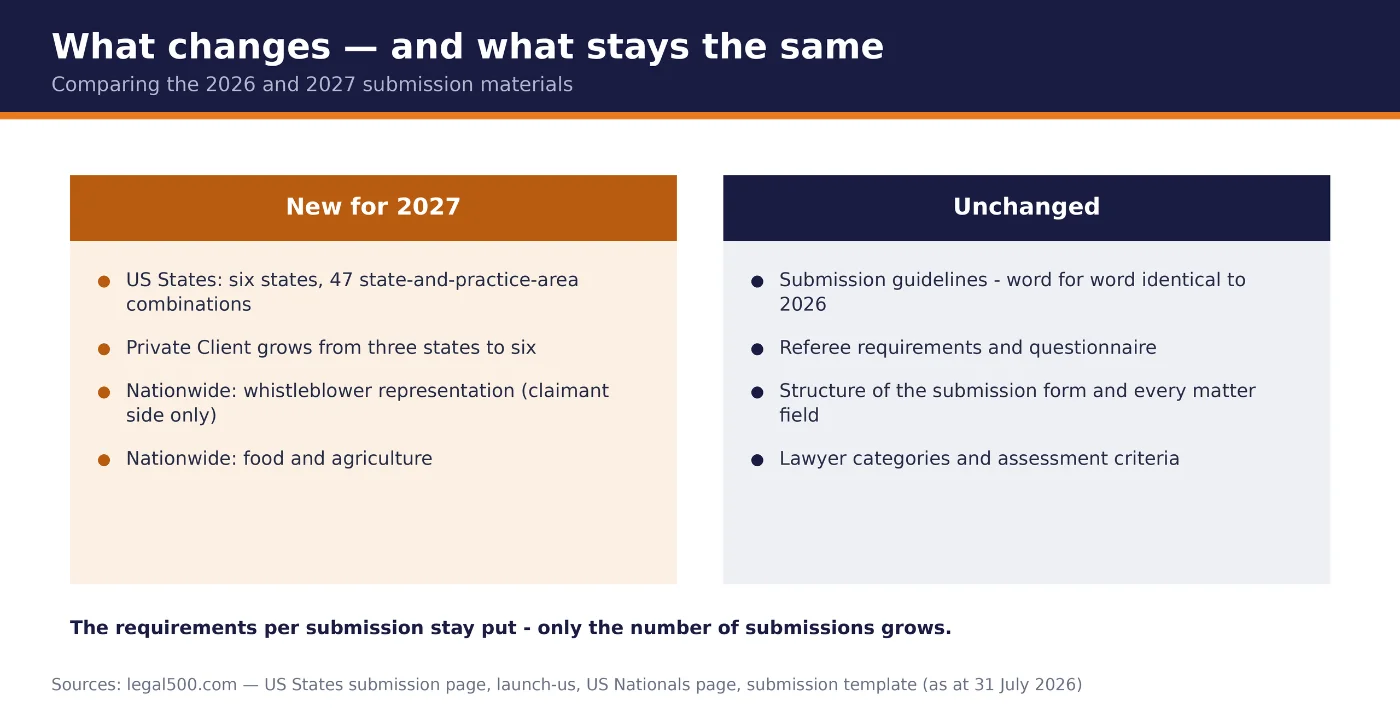
In practice this is the most important finding. There are no new rules, no altered requirements, no new fields. What changes is purely the number of opportunities — and with it the workload. A New York mid-market firm with a private client practice can now submit across four lines, each requiring full matter evidence and client referees.
A note on the deadline (updated 13 October 2026). The US States submission page now gives 30 October 2026; at the end of July it still said 30 September. The Legal 500 research calendar still shows 30 September 2026, and the FAQ names an initial deadline of 9 September with submissions accepted until the research deadline of 4 December 2026. We follow the submission page of each line. Firms wanting certainty should submit as early as possible.
The timeline
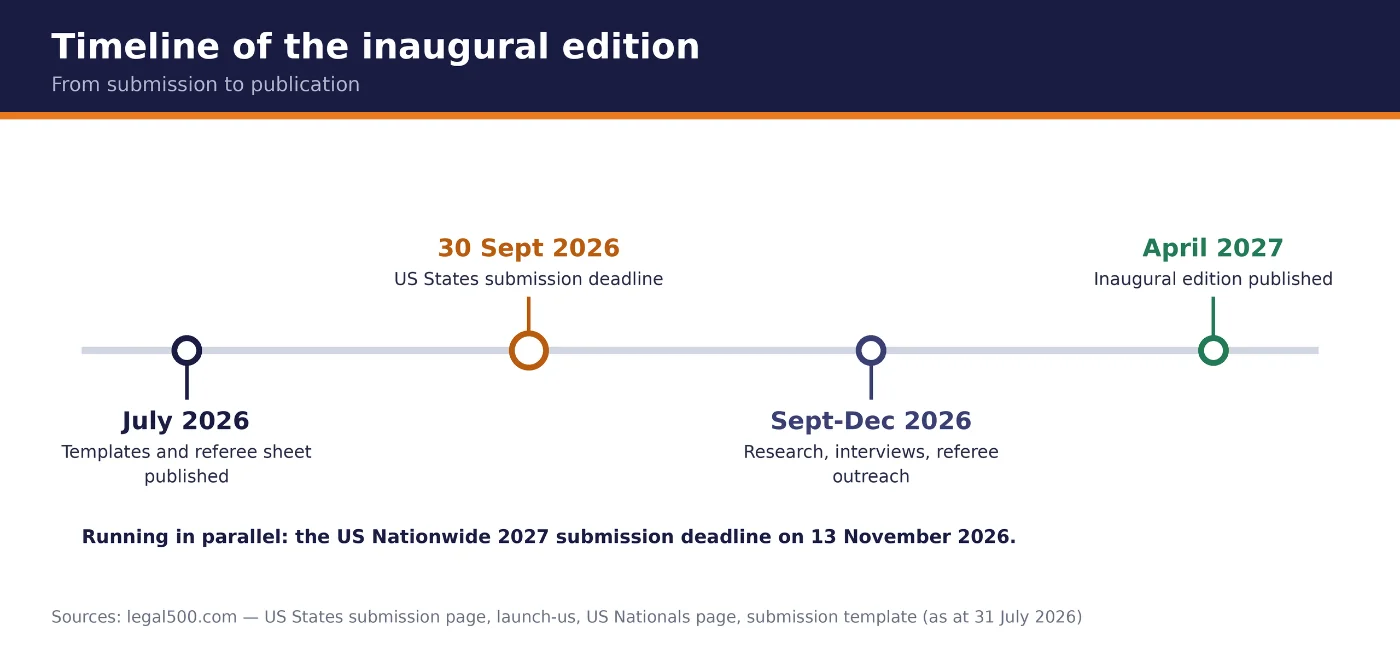
Two weeks after the state deadline, the Nationwide submission deadline follows on 13 November 2026. Firms wanting a presence in both lines can run the matter research once and use it for both submissions.
What this means for firms
The decisive question is not what Legal 500 is restructuring, but what a firm gets out of it. And on that count, the State Rankings sit differently from the rest.
In established tables, moving up is hard
A firm entering an existing Legal 500 practice area today competes against firms that have held their place for years, whose matter history is familiar to the researchers and whose referees are well practised. A newcomer generally lands in the lowest tier and works upward over several cycles — if at all. The order is set, and movement usually only happens when someone stops submitting.
An inaugural edition has no such order
For the six states there is currently not a single published table. Nobody is defending a position, there is no grown hierarchy, no incumbency advantage. Every firm submitting by 30 October is assessed at the same moment and on the same materials. The first edition in April 2027 is what creates the order in the first place — and any firm not in it will face, the following year, exactly the situation that prevails in the established tables today.
There is also a framing that favours mid-market firms: what is assessed is strength within a single state. A firm with three offices in Texas no longer competes against New York names with a thousand lawyers, but against its actual competitive set. Legal 500 puts it that way itself in the webinar materials: the State Rankings highlight firms that dominate their state markets “without competing directly against national giants”.
The provider is more explicit still about the benefit: the new line creates “a clear progression pathway from US Elite → State → National rankings”. That is not marketing filler but a statement about the mechanics. A firm entering at state level now builds the evidence base for the national guide — with the same matters and the same referees. There is also a combination the deck names expressly: firms ranked in the Nationwide Boutique categories may additionally qualify for State and City Elite.
Who should act now
- Mid-market firms in California, Florida, Illinois, Massachusetts, New York or Texas. The inaugural edition is the only chance to be assessed without an existing hierarchy in place.
- Firms with a private client practice in Massachusetts, Texas or Illinois. These three states are researched for the first time — same starting position, same deadline.
- Firms acting for whistleblowers, or in the food and agriculture sector. Whistleblower representation and food and agriculture start from zero in the Nationwide guide.
- Firms already ranked nationally. For them the state line is not a substitute but additional visibility in their home market — drawing largely on material they already hold.
The limiting factor is time. Only a few weeks remain until 30 October, and the requirements on matter evidence and client referees apply in full from the very first edition. The realistic approach is therefore not maximum coverage across every area but deliberate selection: the practice areas where the matter record and referee access genuinely hold up. A weak submission in one more area does more harm than good.
Considering a US rankings submission?
We handle ranking submissions end to end — from matter selection and referee coordination through to the finished document, for Legal 500 as well as Chambers, IFLR1000 and JUVE.
- All ranking deadlines at a glance
- Directories & Rankings: our services
- Legal 500: US States submission page
- Legal 500: US Private Client submission page
- Legal 500: US Nationwide submission page
- Legal 500 webinar “Introducing State Rankings and 2027 research calendar”, 14 July 2026 — with recording and presentation materials
As at 31 July 2026; deadline updated 13 October 2026. Based on the legal500.com submission pages, a direct comparison of the 2026 and 2027 submission guidelines and practice area definitions, the original templates and referee spreadsheets, and the presentation materials from the Legal 500 webinar of 14 July 2026. Deadlines and requirements may be changed by Legal 500; firms should reconcile with the primary source before submitting.