
Every year the same questions come back: which of these guides actually matter, who decides the rankings, what does it cost, and where is the line between a serious directory and a paid badge? This page answers them for the ten guides that matter in Europe — with the wording the publishers use themselves.
What a legal directory is
A legal directory — the market also says law firm ranking, legal ranking or lawyer directory — is a publication that researches law firms and individual lawyers and publishes the result as a ranked table. The tables are cut twice: by jurisdiction and by practice area. So there is a table for banking and finance in Germany, one for patent prosecution in Austria, one for capital markets in the United Kingdom.
Inside a table, firms are not put in a straight order from first to last. They sit in groups. Chambers calls them bands, most other guides call them tiers, JUVE uses stars. Everyone in the same group is treated as equal; the alphabet decides the order within it. That is deliberate: the research can tell a top group from a second group, but it cannot honestly claim that the third firm in band 1 is better than the fourth.
Size is part of the picture, not a side note. A firm can meet every quality criterion and still not appear in the top group because the guide expects a certain depth of team behind the work. This is the single most common misunderstanding when a firm sees its first ranking result.
Where the guides come from
Ranked lists of lawyers are older than the internet by more than a century. Martindale-Hubbell describes its own beginning like this: it "began in 1868 as one man's vision to provide businessmen with the address of 'one reliable law firm…in every city in the United States.'" At first it was an address book. The assessment came later — Martindale names the "1887 edition of Martindale's American Law Directory, which was the first publication to provide such ratings to attorneys".
The guides that shape the market today are much younger. Legal 500 "was founded by John Pritchard in 1987 as the original clients' guide to law firms, the first of its kind". Chambers dates itself to 1990: "Since our founding in 1990 we have dedicated ourselves to delivering detailed rankings and insights into the world's top lawyers, legal departments and law firms." JUVE was founded in Cologne in 1997 — "JUVE wurde 1997 mit der Idee gegründet, das angelsächsische Konzept der Legal Press nach Deutschland zu bringen" (JUVE was founded in 1997 to bring the Anglo-Saxon idea of a legal press to Germany) — and the first JUVE handbook appeared in 1998.
What separated this generation from the old address books was the willingness to publish a judgement. That was not welcomed everywhere. Two Munich lawyers sued JUVE over its rankings; the Higher Regional Court of Munich decided against JUVE (29 U 4292/00) and the Federal Court of Justice declined to hear the appeal (I ZR 155/01). JUVE then went to the Federal Constitutional Court, which on 1 August 2002 granted an interim order only — expressly leaving the substance open: "Bei offenem Ausgang des Hauptsacheverfahrens muss das Bundesverfassungsgericht die Folgen… abwägen" (with the main proceedings still open, the court must weigh the consequences) — 1 BvR 580/02. The story is often retold as a clean win for JUVE. It was not; it was an interim decision, tied to JUVE making the subjective nature of its method more transparent.
Four kinds of directory
Not every guide does the same job, and a firm that treats them all alike wastes effort. Four groups are worth telling apart.
Broad guides across many practice areas
Chambers and Partners, The Legal 500. They cover almost every area of commercial law in almost every market, and they are the reference point most in-house counsel check first.
Guides for one discipline
IAM Patent 1000 and IP STARS for intellectual property, WTR 1000 for trademarks, GAR 100 for arbitration, ITR World Tax for tax. Narrow subject, but researched across many jurisdictions and often in more depth than the broad guides manage.
Guides for one market
JUVE for Germany and Austria. Great depth in one legal culture, published in the language of that market, with editorial standards of its own.
Hybrids and awards
IFLR1000 sits around finance and corporate work and explicitly leaves out other fields. Alongside the rankings, most publishers run award programmes — a second, separate route to visibility.
How a ranking is actually produced
With the exception of JUVE, the guides in this overview work the same way. The firm files a submission, names client referees, the researchers talk to the market, and a research team decides the tables. The weight of each step differs, but the shape is constant.
The submission. A structured document — usually the publisher's own Word template or an online form — in which the firm sets out the size of the practice, arrivals and departures, what it is known for, how it differs from its competitors, and above all the matters of the past twelve months. Matters are the heart of it. IFLR1000 is blunt about this: "Deal evidence is the decisive factor to determine a firm's ranking."
The client referees. Names and contact details of clients who are willing to answer questions about the firm's work. This is where most of the difference is made, and where most firms lose ground. Chambers puts the weight of it plainly: "Our rankings are based on real interviews with your specified references. A reference contact can be a client or anyone who has experience and knowledge of you and your firm over the last 12 months." Leaders League adds a detail worth knowing before you ask a client: "we do not contact clients on behalf of a specific firm but, instead, on behalf of our own organization and research."
The research. Interviews, surveys, public sources. Chambers describes the scale as "Our 330-strong research team conducts over 350,000 interviews and surveys, covering 9,000 firms annually". Legal 500 states: "We contact 300,000 clients asking for feedback on the lawyers they instruct." IAM ran "in the region of 1,800 interviews" over five months for one edition of the Patent 1000.
The decision. Not made by the researcher alone. In the Chambers process "the entire Chambers team involved in the assessment, from researchers to research directors, meets to analyse the findings and determine the final ranking tables."
JUVE is the exception. There is no submission in the Chambers sense. JUVE works with its own questionnaire portal and its own interviews: "Dennoch benutzen auch wir standardisierte Fragebögen für Kanzleien und Mandanten, um die erforderliche Breite der Recherche zu gewährleisten." (JUVE too uses standardised questionnaires for firms and clients, to secure the necessary breadth of research.) Anyone who treats a JUVE questionnaire like a Chambers submission produces a document that does not fit the process. How the JUVE rankings work in detail →
Where the official forms are
The templates are public. Both Chambers and Legal 500 publish their current submission forms and referee spreadsheets, and both change them from year to year — always download the current file rather than reusing last year's.
Chambers submission forms
Europe · Germany · France · UK Solicitors · UK Bar · UK Bar, sole practitioners · USA · Canada · Brazil · Latin America · Asia-Pacific · Greater China · Middle East, Israel, Africa, Caribbean, Offshore · Global Market Leaders · Foreign Expert and Foreign Desk · Referee spreadsheet
Legal 500 submission information
Europe, Middle East & Africa · United Kingdom, Solicitors · United Kingdom, the Bar · Canada · Caribbean · Latin America · Asia Pacific · Green Ambassadors · all editions
All links checked on 11 September 2026. The Chambers research schedule with the current deadlines is at chambers.com/about-us/research-schedule.
Do you want to succeed in the rankings?
We have been preparing ranking submissions since 2004 — for firms of every size, across Germany, Austria, Switzerland and Italy.
What it costs to take part
For the serious guides, the answer is nothing — and several of them say so in writing. Chambers: "Submitting to Chambers is free." IFLR1000: "There is no cost to participate in the research." IP STARS: "There is no cost or fee to pay to participate in our research. Participation in our research does not guarantee a ranking, and we do not rank all firms and individuals offering IP services." ITR World Tax puts the same point as a flat no: "Can firms pay to be ranked? A: No. Our rankings are based entirely on the independent research carried out by our research analysts."
Legal 500 is free for the part that counts — "There is no cost to make an editorial submission. Editorial is independent and advertisers do not receive preferential treatment" — and sells paid profiles separately, which are written by the firms and not by Legal 500. The distinction is worth keeping straight when someone tells you a directory "charges".
For IAM, WTR 1000, GAR 100 and Leaders League we did not find a sentence on their own pages that confirms participation is free, so we do not claim it here. Read the current research page before you plan a budget.
Pay-for-play: how to recognise it
Alongside the researched guides, an industry of paid badges has grown up. The pattern is always the same: an unsolicited email announcing that your firm has "been selected", a price list for the logo, the plaque and the profile, and no research behind any of it. Some of these publications look convincing at first glance.
Three questions usually settle it:
1. Is the method published? Every serious guide has a methodology page that explains what is researched and how. If there is none, or if it is one vague paragraph, stop there.
2. Does the award depend on a payment? "Recognition is free, the logo licence costs €2,400" is the same thing as selling the award.
3. Is anyone ever not ranked? A list that includes everyone who answers is not a ranking. IP STARS says the opposite in one sentence: "we do not rank all firms and individuals offering IP services."
The damage is not only the money. A badge that the market recognises as bought says something about how carefully a firm chooses its partners — which is precisely the opposite of what the badge was meant to say.
The ten guides that matter in Europe
Every entry below rests on the publisher's own wording. Where a publisher does not state something, we say so instead of filling the gap.
Chambers and Partners
Founded in 1990, based at 165 Fleet Street in London, and by its own description "present and relied on in over 70 countries and 200 jurisdictions". Note the wording: 200 jurisdictions, over 70 countries. A jurisdiction can be a US state or a separate bar ranking, so the two numbers are not interchangeable — an error that travels widely.
Firms and individuals are placed "in bands from 1 (highest) to 7 (lowest)", with additional labels such as Senior Statesperson, Eminent Practitioner, Up and Coming and Associate to Watch. Submitting is free. Deadlines are not one date but many: "Deadlines are dependent on practice area and location, all of which can be found in our research schedule."
In November 2023 Chambers changed hands. Its then owner Inflexion announced the sale to Abry Partners with the words: "The sale values Chambers at over £400 million and marks a highly successful exit for Buyout Funds IV and V, generating a 4.7x return." The figure is often quoted with the wrong year; the announcement is dated 10 November 2023.
The Legal 500
The oldest of the modern guides: "Legal 500 was founded by John Pritchard in 1987 as the original clients' guide to law firms, the first of its kind." It is published by Legalease Ltd in London and today describes itself as "a data-driven, AI-optimised research platform which benchmarks, informs and connects providers and users of legal services in over 100 countries worldwide".
Client feedback is collected at a scale that surprises most firms: "We contact 300,000 clients asking for feedback on the lawyers they instruct." Firms sit in tiers; individuals can additionally be named Hall of Fame — reserved for lawyers who "must be widely regarded as being at the very top of the profession, and to have been consistently ranked as leading individuals by Legal 500 for a number of years" — Leading Individual, or Next Generation Partner, for "lawyers with (generally) five years or fewer at partner level".
There is no single deadline. "We publish over 10 different editions, and each has its own deadline."
JUVE
The reference point in the German-speaking market. The publisher was founded in Cologne in 1997 and has belonged to the NWB group since 2016 — "Rückwirkend zum Jahresanfang hat der Fachverlag NWB alle Anteile des Kölner Branchenpresseverlages JUVE übernommen." (NWB acquired all shares in the Cologne publisher JUVE, backdated to the start of the year.) The first JUVE handbook appeared in 1998.
The rating groups are shown as stars: "Grundsätzlich sind die einzelnen Gruppen mit ein bis fünf Sternen ausgezeichnet." (As a rule the groups are marked with one to five stars.) Where a table has only four groups the one-star mark is dropped, where it has three, the two-star mark goes as well — so a star count is only readable against the table it sits in.
The research year starts earlier than most firms expect: "Die Redaktion beginnt bereits im Oktober mit den Recherchen für das jeweils folgende JUVE Handbuch. Erster Abgabetermin für Fragebögen der Kanzleien ist im Januar des Folgejahres, weitere Termine liegen im März und im Juni." (Research for the next handbook starts in October; the first questionnaire deadline is in January, two more follow in March and June.) Alongside the German handbook there is a ranking for Austria, and the English-language JUVE Patent, which states: "In the future, JUVE Patent will only publish a ranking of the national markets in France, the UK, and the Netherlands every two years."
IFLR1000
"Launched in 1990, IFLR1000 provides customers with firm and lawyer benchmarking across 75 practice areas within the Financial & Corporate legal market." What it leaves out is unusually clear, and worth reading before you plan a submission: "IFLR does not research arbitration, competition, disputes, employment, IP, life sciences, litigation, or tax work."
Reach is stated as "more 5000 law firms and over 23,000 lawyers across 250 jurisdictions". Again: jurisdictions, not countries — IFLR counts national and regional or state-level legal frameworks separately. Participation is free: "There is no cost to participate in the research."
One sentence explains more about IFLR than any ranking table: "Deal evidence is the decisive factor to determine a firm's ranking." Firms are placed in tiers, individuals carry ratings from Market Leader ("This is the highest rating") through Highly Regarded down to Notable Practitioner and Rising Star. Deadlines run by region — Western Europe closed on 26 January 2026, Asia-Pacific on 6 March 2026, the Middle East on 30 June 2026.
GAR 100 — Global Arbitration Review
GAR itself was "launched in 2006" and is published by Law Business Research; the GAR 100 guide came a little later, and the 2025 edition is the eighteenth. It is the guide for arbitration practices: "Each year GAR publishes our unique signature survey: the GAR 100, a guide to specialist arbitration firms worldwide."
The name is misleading in two ways. First, it is long past 100 firms — "With this edition – our 18th – we selected 218 firms from 57 countries." Second, the list is alphabetical but there is a real ranking inside it: the GAR 30, built on hard numbers rather than impressions. The survey "looks at: merits hearings and jurisdictional hearings in a two-year period and the amount of money at stake; the number of hours billed to arbitration in the past two years; the number of lawyers at the firm who were peer-selected for inclusion in our sister publication Who's Who Legal: Arbitration; and the number of pending cases in which a firm's members have been appointed as arbitrators." Places 31 to 40 are listed alphabetically "as the difference in grading between them is minimal".
IAM Patent 1000
The patent guide from Law Business Research, in its fifteenth year with the 2026 edition. It covers "firms and individuals engaged in patent prosecution, transactions and patent litigation in over 60 jurisdictions" — and where a market is developed enough, it splits those three strands into separate tables, which is why a filing practice and a litigation practice can sit in different bands at the same firm.
Participation runs on three legs: "Firms participate in our research by providing written submissions and client contact details for reference purposes – and by making leading patent practice representatives available for interviews." The interview volume is substantial — "Over five months, IAM conducted in the region of 1,800 interviews with numerous attorneys at law, patent attorneys and in-house counsel". Recommendations are "presented in gold, silver and bronze bands"; gold is reserved for those the guide calls "the crème de la crème".
IP STARS
Managing IP's guide, with a longer history than the brand suggests: "Managing IP published its first legal directory in 1994 and rebranded it in 2013 as IP STARS." It is "an exclusive annual publication based on a six-month research project, starting from September each year. The research covers a variety of IP practice areas and more than 70 jurisdictions."
The subject range is wider than the four or five categories usually named. Alongside prosecution and disputes for patents and trade marks, the methodology lists copyright and related rights, life sciences IP, ITC litigation, PTAB litigation, IP transactions, trade secrets, design and domain name disputes. Firms sit in tiers or are marked highly recommended or recommended; individuals can be an IP Star ("a very experienced senior IP practitioner"), a Rising Star or a Notable Practitioner.
Taking part costs nothing and guarantees nothing: "There is no cost or fee to pay to participate in our research. Participation in our research does not guarantee a ranking, and we do not rank all firms and individuals offering IP services." The cycle is fixed — submissions open on 1 September, the questionnaire and client referees are due on 2 November.
WTR 1000
The trademark counterpart, published by Law Business Research. "The WTR 1000 focuses exclusively on trademark practice" and "identifies the leading professionals and firms that are deemed outstanding at obtaining, protecting, managing, enforcing and monetising trademarks" in "over 80 key jurisdictions globally".
Within a market it runs separate tables "in the respective areas of prosecution and strategy, enforcement and litigation, and anti-counterfeiting" — three strands, not two, and anti-counterfeiting is the one firms most often forget to evidence. As with IAM, firms and individuals are placed in gold, silver and bronze bands, and the method is the familiar three-part one: "Firms participate in our research by providing written submissions and client contact details for reference purposes – and by making leading trademark practice representatives available for interviews."
ITR World Tax
Tax and nothing else: "World Tax focuses solely on tax in line with the scope of our sister publication ITR." The tables follow the way tax work is actually organised — general corporate tax, transfer pricing, indirect tax and tax controversy each have their own definition in the methodology.
Two sentences are worth quoting to anyone who suspects rankings can be bought. "Participation is free, however submitting does not guarantee a tier ranking, an award shortlisting or win." And: "Can firms pay to be ranked? A: No. Our rankings are based entirely on the independent research carried out by our research analysts."
ITR also states what it is measuring, which few guides do so directly: "Our rankings are qualitative not quantitative so we judge firms on the complexity of their work and the legal innovation they can demonstrate as opposed to the number of transactions they have completed." Firms run from Tier 1 — "International or very strong regional presence and reach… Receives strong and consistent praise from referees and peers" — down to Tier 5, with an Other Notable category for firms that took part but did not provide enough data. One practical rule catches people out: "Client referees should have worked with the firm within the previous 18 months."
Leaders League
"Founded in 1996 in Paris, Leaders League is an international rating agency and business services" company, with offices in Paris, London, Madrid, Milan, Lima, Rio de Janeiro and São Paulo. Firms complete "a submission form where detailed information is requested on the firm's performance in the last 12 months", including "the top 10 cases in the last year" — a strict rolling window that decides which matters are even eligible.
The referee handling is different from the Anglo-Saxon guides and should be explained to clients in advance: "we also contact all clients listed in the referee forms by firms that submit (removing any contacts duplicated from our database)", but "we do not contact clients on behalf of a specific firm but, instead, on behalf of our own organization and research." Research runs in three cycles a year; for 2026 the published submission deadlines were 13 March, 19 June and 23 October.
All deadlines in one place
Every submission date for all of these guides, by country and practice area, with calendar export: Directories & ranking deadlines →
Why a ranking is worth the effort
Legal services are hard to judge before you buy them. Even a client who worked well with a firm three years ago cannot easily tell whether the team is still the same, whether the neighbouring practice group is as strong, or whether the firm still fits a company of that size. A personal recommendation answers part of that. A ranking answers a different part: it is structured, it is repeated every year, and it comes from outside the firm.
That outside view is the whole point. An assessment by third parties carries weight that a firm's own description of itself never will — and directories are built to be read by people who are not lawyers. Matters are described in plain terms, so a technology company can see what a firm actually did in a transaction without following the legal detail.
There is a second, less comfortable reason, and in-house teams talk about it openly. Choosing outside counsel always carries risk. When something goes wrong, the question that follows is not "was the advice correct" but "how was this firm selected". A decision that can be traced to a published, independent table is far easier to defend than one that rests on an acquaintance from a conference. Rankings are, among other things, a documented selection criterion.
One measure of how much weight the market puts on these guides: when Chambers was sold in November 2023, the transaction "values Chambers at over £400 million". Few law firms would fetch that. Sitting inside a brand with that reach costs a firm nothing but the work of a good submission.
In our own work since 2004 the pattern that repeats is this: the ranking itself rarely wins a mandate on its own, but it decides whether a firm is on the shortlist at all. It also does quiet work in two places firms underestimate — referrals from firms in other countries who have no other way to judge a market, and recruitment, where candidates check the tables before they apply. That is our experience rather than a published statistic, and we flag it as such.
Building a directory strategy
Submitting to everything is the most common mistake and the most expensive one. A strategy is mostly a set of decisions about what not to do.
Choose the tables you can realistically enter
Pick jurisdictions and practice areas where the work of the last twelve months genuinely fits the guide's definition of that table. A strong submission in the wrong table beats nothing — but only just.
Treat the lower band as the target
First entries almost never land at the top. Getting into the table at all, then moving one band, is the realistic path; it usually takes one to two research cycles.
Collect matters as they happen
Not in the week before the deadline. Record value, complexity, cross-border element, your side's role and the outcome while the team still remembers them.
Choose referees who will answer
A prominent client who never replies is worth nothing. Ask first, explain what will arrive and when, and prefer the person who actually instructed you.
Two more points decide more than the wording of any single matter. Consistency: steady performance year after year moves a firm further than one spectacular case in an otherwise quiet year — the researchers are comparing you with last year as well as with your competitors. And positioning: a clear answer to what the practice is known for, in a sector, a product or a type of dispute, is what lets a researcher place you at all.
Frequently asked questions about legal directories
Which guide should a firm start with?
For broad international visibility, Chambers and Partners and The Legal 500 are the two that clients check most often; in Germany and Austria, JUVE carries comparable weight. If the practice is concentrated in one discipline — patents, trademarks, tax, arbitration — the specialist guide often gives a better return for the same effort, because the field is narrower and the research goes deeper.
Does taking part cost anything?
For the serious guides, no. Chambers states "Submitting to Chambers is free", IFLR1000 "There is no cost to participate in the research", IP STARS "There is no cost or fee to pay to participate in our research", and ITR World Tax answers the question "Can firms pay to be ranked?" with "No." At Legal 500 the editorial submission is free; paid profiles exist separately and are written by the firms themselves.
Does a good submission guarantee a ranking?
No, and the publishers say so themselves. IP STARS: "Participation in our research does not guarantee a ranking, and we do not rank all firms and individuals offering IP services." ITR World Tax: "submitting does not guarantee a tier ranking, an award shortlisting or win." The submission is the part you control; the referee responses and the market interviews are not.
How long does it take to see a result?
Plan for one to two research cycles. A first entry or a move of one band within twelve to twenty-four months is a realistic expectation when the matters fit the table and the referees reply. Anything faster is luck rather than method.
Can a small firm be ranked?
Yes. Size shapes which band is reachable, not whether you appear at all. What decides it is whether the matters submitted meet the definition of that practice area — and whether the referees respond.
What is the difference between a ranking and an award?
A ranking is the result of research across a whole market and is repeated every year on the same basis. An award is a decision about a single year, often with a shortlist and a ceremony. Both can be useful. The test is the same for both: is there a published method, and is anyone ever left out?
Is a directory consultant worth it?
It depends on what is missing. If the firm has the material and the capacity, it can do this itself — the templates are public. Outside help pays for itself where there is no business development capacity, where a firm is entering a new market or practice area for the first time, or where results have been flat for years without anyone being able to say why.
How Law Business has supported firms since 2004
See our services for ranking submissions
We prepare ranking submissions for law firms in Germany, Austria, Switzerland, Italy and beyond — from the first strategic decision about which tables to target, through matter selection, drafting and referee management, to filing and interview preparation. We have been doing only this, alongside law firm marketing and positioning, since 2004.
The standard work on law firm rankings comes from us
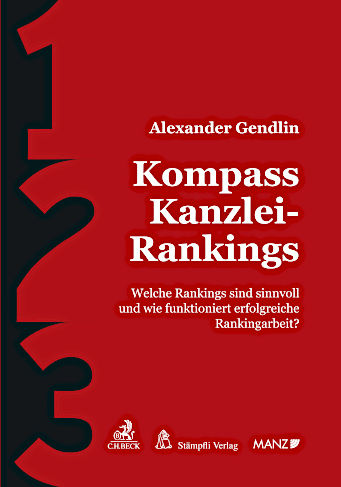
Law Business Managing Partner Alexander Dillinger wrote, in cooperation with prominent rankings including Chambers, Legal 500 and Thomson Reuters, the first book worldwide on law firm rankings — the "Kompass Kanzlei-Rankings", published by C. H. Beck, MANZ and Stämpfli.
Would you like to know which of these guides are realistic for your firm, and what a submission would involve in practice? Get in touch — we will look at your current position and tell you honestly where movement is possible and where it is not.
About this article
Mag. Alexander Dillinger, Managing Partner of Law Business. In the legal industry since 2004, previously Head of Business Development & Marketing at Wolf Theiss and DORDA. Author of the "Kompass Kanzlei-Rankings", published by C. H. Beck, MANZ and Stämpfli — with contributions from Chambers and Partners, The Legal 500 and Thomson Reuters.
Every statement about a directory on this page was checked against that publisher's own pages on 11 September 2026; passages taken from those pages are marked as quotations. Where a publisher does not state something, we say so rather than estimate. If you spot an error, let us know — we will correct it.
"Law Business took over the complete preparation of our ranking submissions… we improved at Chambers and Partners […] and Legal 500."
PHH Prochaska Havranek
Dr Rainer Kasper · Managing Partner